
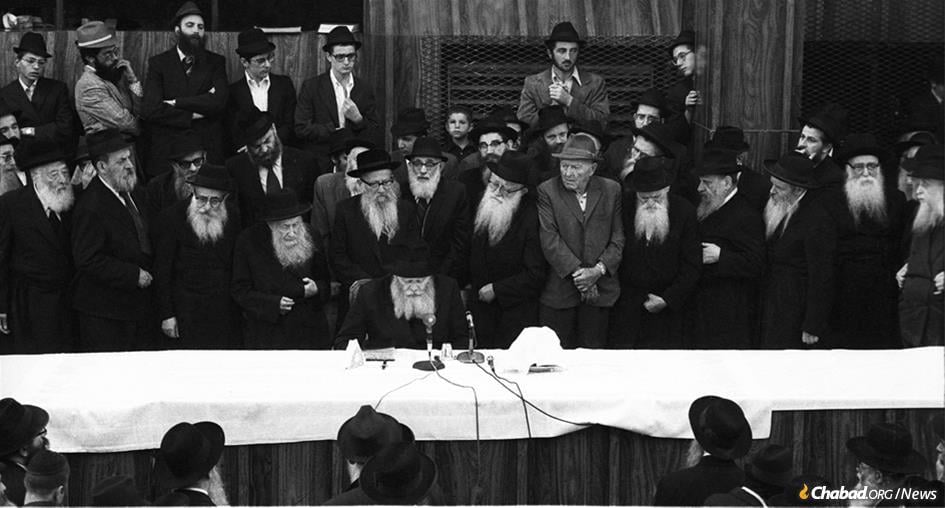
For the past 3,338 years, the holiday of Shavuot has commemorated G‑d’s giving of the Torah to the Jewish people at Sinai. Chassidut teaches that it is not just a commemoration, but that the yearly celebration is, in fact, a re-living of the revelation that took place all those years ago.
Nowhere was the experience of receiving the Torah felt more powerfully than in the presence of the Rebbe—Rabbi Menachem M. Schneerson, of righteous memory. Shavuot in the Rebbe’s presence gave tangible expression to the essential bond between G‑d, the Torah and the Jewish people, as well as to the renewed acceptance of the Torah each year. Though formally limited to two days, the spirit of the festival was felt for weeks beforehand and long afterward.
A unique glimpse into what the “Giving of the Torah” was like in the Rebbe’s court is offered to us in the journals of Zalmon Jaffe, an English businessman and Chassid who spent every Shavuot in the Rebbe’s court from the early 1960s to 1994. Known for his trademark wit, he recorded his experiences in yearly installments that were vivid, personal, meaningful—and oftentimes hysterical.
Using his diaries, along with other firsthand accounts, we will attempt to recreate some measure of that experience.
The Days of Preparation
In the days preceding Shavuot, the Rebbe would address the annual convention of the Lubavitch Women’s Organization, held at Chabad World Headquarters at 770 Eastern Parkway in Brooklyn, N.Y. Founded at the Rebbe’s request, the organization offered women the opportunity to take an active role in community life. Each year, its convention featured a special address from the Rebbe directed specifically to women, and the Rebbe would also pen a letter to the convention’s “leaders and participants.”
In both the addresses and letters, the Rebbe emphasized the unique role women play in Jewish life and continuity. He frequently highlighted the central role women played during the Exodus, citing the teaching of the sages that “in the merit of the righteous women, our ancestors were redeemed from Egypt.” He likewise pointed to the Giving of the Torah, when G‑d instructed Moses to speak first to the women and only afterward to the men.
Starting in the 1980s, a rally for children would also be held in the weeks leading up to Shavuot, and the Rebbe would attend these gatherings as well. Speaking to children on their level, he would convey ideas they could understand, bolstered with examples they could relate to.
These gatherings, held at a time when the Rebbe could have chosen to prepare for Shavuot through personal Torah study, underscored his approach that the Giving of the Torah needed to involve every single member of the Jewish people: men, women and children.
Since 1980, this message was further emphasized through the Rebbe’s campaign encouraging every child, even young infants, to be present at the reading of the Ten Commandments in synagogue on Shavuot. Pointing out that at the original event every Jewish child was present, in the weeks preceding Shavuot, the Rebbe would therefore urge Chassidim to ensure that every child could attend by publicizing the times and locations of readings, reaching out to Jewish families, and explaining the significance of participating.
As the days were counted toward Shavuot, the Rebbe would issue a pastoral letter addressed “To the sons and daughters of our people Israel, everywhere,” containing messages related to the holiday. These letters often incorporated themes unique to that particular year, such as the days of the week on which Shavuot fell, distinctive features of the Jewish calendar and the lessons that could be derived from them.
Shavuot also brought an influx of visitors who came to spend the holiday with the Rebbe. Prominent among them were congregational rabbis arriving from across the United States, Europe and Israel.
The large number of visiting rabbis was tied to an early Chassidic tradition. Since Passover and the High Holidays involve numerous mitzvot and rituals, rabbis were generally required to remain with their communities during those times to assist them in fulfilling these mitzvot and to answer any questions that might arise. Shavuot, however, with its comparatively simpler halachic requirements, afforded them the opportunity to travel and visit the Rebbe. The visiting rabbis were welcomed by the local community and by the leadership of Chabad institutions, often at specially organized receptions and gatherings.
Finally, Shavuot arrived. The holiday ushered in 48 hours of prayer, study, devotion and connection, experienced in the presence and participation of the foremost Torah scholar and leader of the generation.

Receiving the Torah Anew
The holiday began with the evening prayers, followed by the festive meal. Until 1971, the Rebbe and his wife—Rebbetzin Chaya Mushka Schneerson, of righteous memory—would join the holiday meals hosted by her mother—Rebbetzin Nechama Dina Schneersohn, of righteous memory—in the second-floor apartment at 770, where the Sixth Rebbe had lived.
These meals, which also took place for the three subsequent holiday meals, gave the small invited gathering an opportunity to discuss topics with the Rebbe, ask questions and receive answers in a more intimate setting than a public farbrengen.
Since he first began visiting for Shavuot, Zalmon Jaffe was among the invited guests. With his distinctive humor and style, he often brought smiles to the faces of the Rebbe and the other participants.
In his diary, Jaffe records how, during the 1968 meal, he discussed with the Rebbe the success of Chabad in Manchester and the need to expand to other cities. “The best and most wonderful moment,” Jaffe later wrote, “was when I quoted someone who had said to me that if you wanted to erect a new building, you simply got the money and put it up.
“‘Anyone,’ I answered, ‘can put up a building with money. The kuntz [‘trick’] is to put it up without money.’
“The Rashag [Rabbi Shmaryahu Gurary, the Rebbe’s brother-in-law] then interjected, ‘How did you build, then?’
“‘With the Rebbe and his brochos,’ I replied.
“What a precious moment it was! Everyone was delighted with this answer, because it underscored that when one carried out the Rebbe’s instructions, it would ultimately be crowned with success.”
Following the meal, it is customary to recite Tikkun Leil Shavuot, a syllabus containing excerpts from every book of Tanach, selections from the Mishnah and Kabbalah, as well as a listing of the 613 mitzvot. The synagogue at 770 would fill with those who came to recite it.
Until 1971, the Rebbe would remain in his office on the ground floor of 770 for the duration of the learning session. Then, at around 3 a.m., he would enter the synagogue and deliver a Chassidic discourse.
Concentrating on Chassidic teachings being presented publicly for the first time could be challenging under any circumstances; at three in the morning, even more so. Yet this did not deter the ever-growing number of Chassidim who gathered to hear the Rebbe’s words. Many would remain afterward to review the newly delivered teachings—some staying awake well past daybreak as others briefly retired for sleep.
Rabbi Yoel Kahn, the foremost scholar of Chassidut and the principal transcriber of the Rebbe’s oral teachings, described the first such occasion, in 1952, in a letter to his family:
“Upon completing Tikkun, some people began studying while others simply remained in 770 until morning, when it was time to go to the mikvah. Unfortunately, I too had gone to the mikvah, and while I was away, the Rebbe suddenly entered the synagogue and asked, ‘Where is everyone?’ Only about fifteen people were still there.
“The Rebbe then removed his coat, sat down in his place, and instructed that a niggun be begun in preparation for a ma’amar [discourse]. In the meantime, someone was sent to the mikvah to inform us that the Rebbe had appeared in the synagogue. I met the messenger at the door on my way out and, hearing the news, immediately ran back to 770, where I found the Rebbe already in the midst of the ma’amar, with a crowd of only thirty people …
“When the Rebbe concluded the maamar, we sat down to review it … After prayers I reviewed the maamar once more for those who had not been present when it was delivered, and then again that night … ”
Rabbi Kahn continues that an individual had had a private audience with the Rebbe the day after Shavuot, and the Rebbe asked about if the maamar was reviewed. Upon hearing that it was reviewed three times, the Rebbe was visibly pleased and said, with a smile: “No one tells me good news. A maamar was reviewed three times, and about such things no one bothers to notify me … ”
Starting in 1971, the Rebbe discontinued the practice of delivering a maamar in the early hours of Shavuot morning and instead began holding a farbrengen on the night before Shavuot, during which he would recite a Chassidic discourse.
Despite everyone remaining awake throughout the night, morning prayers in 770 began at precisely 10 a.m., the regular scheduled time. The festival prayers were followed by the reading of the Ten Commandments. As the Rebbe had encouraged, large numbers of children attended, together with their parents, and mothers brought even young infants to hear the reading.
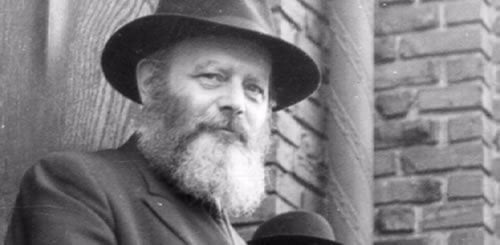
If one imagined that the Chassidim would then take the opportunity to catch up on sleep, the reality was quite the opposite. After the daytime holiday meal, Chassidim would return to 770, where they gathered before heading out on foot to nearby Jewish communities to share Chassidic teachings connected to the holiday. Before departing, the large procession assembled outside 770, where the Rebbe would come out to see them off before they dispersed to the many synagogues located within walking distance.
“On the first day of Shavuos, after an early Mincha, about 2,000 bochurim and men took part in the ‘best ever’ march to many of the shuls in the Boro Park neighborhood—five miles each way—with wonderful ruach [‘spirit’] and singing,” Zalmon Jaffe wrote in his diary. “Police cars and cyclists escorted the walkers. One Lubavitcher addressed each congregation between the Mincha and Maariv prayers.
“After Maariv, everyone walked back to Crown Heights. They did not return until about one in the morning. Having now completed the ‘10-mile march,’ they gathered outside the Rebbe’s home, lustily singing and dancing, covered with perspiration. After that, it was ‘dinner’ time!”
The following day brought the regular holiday prayers and meals. As the festival drew toward its close, another gathering would be held in 770: a farbrengen presided over by the Rebbe.
During it, the Rebbe would deliver talks on themes connected to the holiday, alongside explorations of subjects in Talmud, Jewish law, philosophy and Chassidus. A ma’amar was also typically recited. Certain themes reliably returned each year, among them the yahrzeits of the Baal Shem Tov, founder of the Chassidic movement, and King David, which falls on Shavuot; encouragement to study the daily portions of Chumash, Tehillim and Tanya, collectively known as “Chitas”; and mention of the upcoming Kinus Torah, a gathering held the following day in 770, where local and visiting rabbis would deliver lectures spanning all areas of Torah scholarship.
The Rebbe himself participated in the Kinus Torah by often contributing a specially prepared talk focused on Talmudic or halachic analysis in the style appropriate for the Kinus Torah.
According to the clock, the holiday formally ended sometime during the farbrengen. But in 770, the words of Torah and the Chassidic melodies continued long past midnight. Even after the farbrengen concluded and Havdalah was recited, the Rebbe would remain for several additional hours to distribute kos shel bracha, a small portion of wine from the cup over which the blessing had been made, to the thousands who filed past him.
The atmosphere of Shavuot continued in the days that followed as well. Between the Kinus Torah, private audiences for guests and additional farbrengens held by the Rebbe after the holiday, the spirit of Shavuot extended far beyond its formal two days.
Or, as Zalmon Jaffe concluded the Shavuot experience by the Rebbe: “From the above, you can see that Shavuos at 770 is a very relaxing and restful time!”





Start a Discussion